March 22, 2026 at 12:00 PM UTC
The war that keeps winding down — Week Three of the US-Israeli campaign against Iran
The week at a glance
Day 16 through Day 23. The third week of Operation Epstein Furry opened with Israel striking the world's largest natural gas field, continued with Iran firing ballistic missiles at a base in the Indian Ocean that most Americans have never heard of, passed through the public hanging of three young protesters in a holy city, and closed with the President of the United States giving Iran forty-eight hours to reopen a waterway or he would start blowing up their power grid.
In between, the administration told Congress it would like $200 billion to keep this going, told the press it was "winding down," and told the Pentagon to send 2,500 more Marines.
The week, in other words, was coherent in exactly the way this war has been coherent from the start — which is to say, not at all.
The human cost
The numbers are getting harder to verify and easier to ignore. By March 17, the Human Rights Activists News Agency (HRANA) — the most methodical tracker of civilian casualties in Iran — had documented 3,114 killed since the bombing began on February 28. Of those, 1,354 were civilians, 1,138 were military personnel, and 622 remained unclassified. At least 207 were children.
The Kurdish human rights organization Hengaw, which relies on a different methodology and a broader network of field reporters, placed the toll significantly higher: more than 5,300 dead through the first eighteen days of the war. The discrepancy is itself a data point — when the dead pile up this fast, even the people counting them cannot agree on the total.
By Day 22, HRANA reported that more than 50% of all strikes were now targeting Tehran, with cumulative civilian fatalities rising to at least 1,406, including 210 children. The numbers will be revised upward. They always are.
In Lebanon — a country that did not start this war and was not consulted about it — more than 1,000 people are dead and roughly one million have been displaced. Across Iran, the displacement figure stands at approximately 3.2 million, a number large enough to constitute a mid-sized European country.
Thirteen American service members have been killed. More than 200 have been wounded, though the Pentagon notes — reassuringly — that most injuries were minor and more than 180 troops have "already returned to duty." The dead have not returned to anything.
Amnesty International's investigation into the March 8 strike on the Shajarah Tayyebeh elementary school in Minab concluded that the attack killed more than 110 children. The organization called it "a war crime that demands accountability." No one has been held accountable.
The energy war
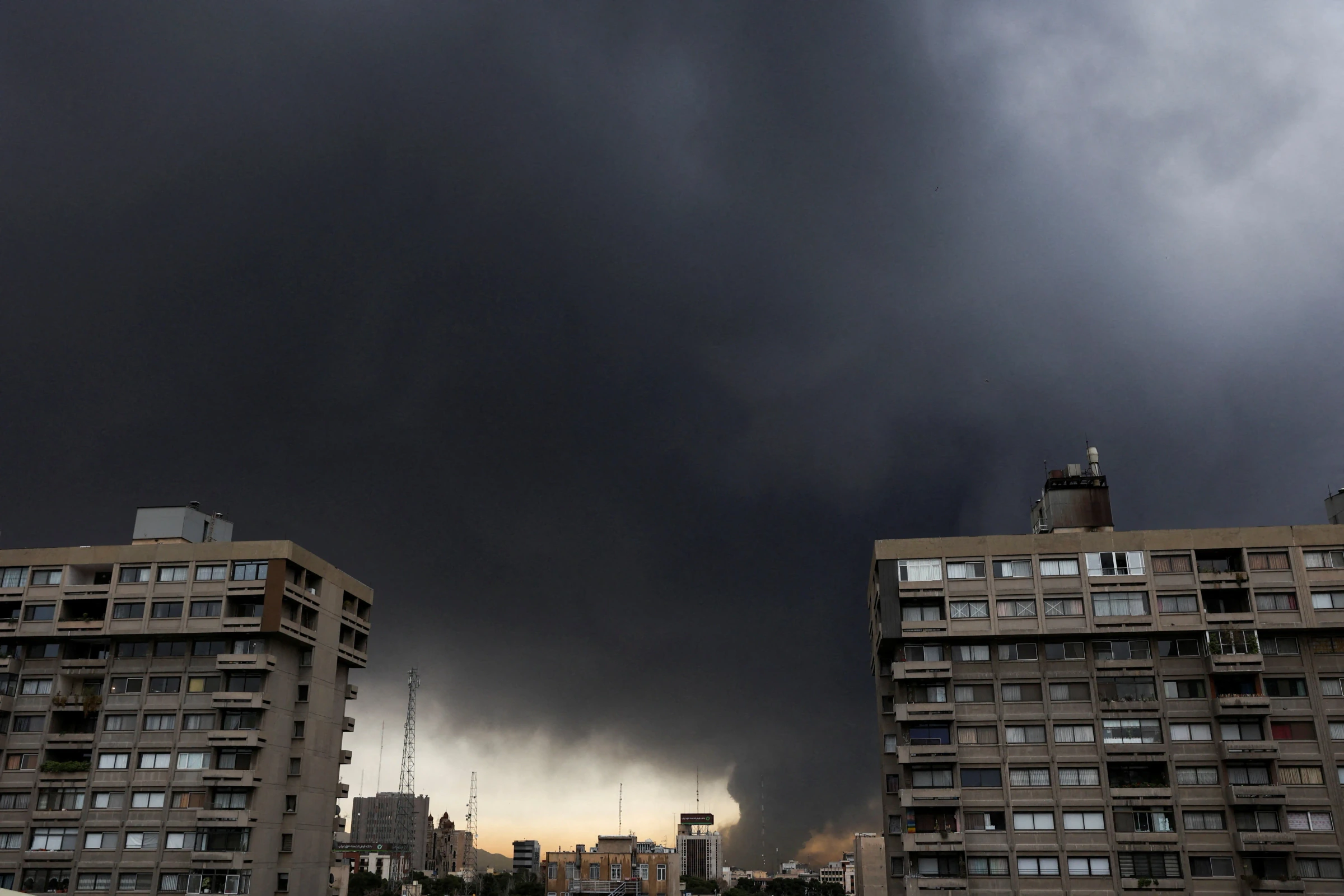
On March 18, Israel struck Iran's South Pars gas complex — the largest natural gas field on Earth, jointly operated by Iran and Qatar (which calls its side the North Dome). The strike hit gas processing facilities and the adjacent Asaluyeh oil refinery. Israel confirmed the operation. The United States said it was not directly involved, which is a thing the United States says.
Iran's response was not symbolic. Within hours, the Islamic Revolutionary Guard Corps announced that five energy facilities across the Persian Gulf would be targeted: Saudi Arabia's SAMREF refinery and Jubail petrochemical complex, the UAE's Al Hosn gas field, and Qatar's Ras Laffan refinery and Mesaieed petrochemical complex.
The retaliatory strikes on Ras Laffan Industrial City caused what QatarEnergy called "extensive damage to the Pearl GTL facility." Qatar's energy minister, Saad Sherida al-Kaabi, said the attack reduced Qatar's liquefied natural gas capacity by 17% and would result in an estimated $20 billion in annual revenue losses. Qatar did not start this war either.
Brent crude closed the week at $106 per barrel — up more than 40% since February 28. Some intraday trading pushed above $110. The average price of a gallon of gasoline in the United States hit $3.70, up from $2.93 a month ago. When you bomb the country that controls the Strait of Hormuz — through which roughly 20% of the world's oil and liquefied natural gas flows — the math is not complicated.
Shipping through the Strait has, in the words of naval analysts, "virtually ground to a halt." Iran says the waterway is open to everyone except the United States and its allies, a distinction that covers most of the ships that use it.
The money
Three weeks of air operations, naval deployments, missile defense, and Tomahawk salvos have cost the United States somewhere between $31 billion and $34 billion, depending on which Pentagon accounting method you prefer. That works out to a burn rate of roughly $891 million to $2 billion per day — a range so wide it tells you how little anyone actually knows about where the money is going.
More than 50,000 US troops are now deployed in the region, supported by carrier strike groups, amphibious assault ships, bomber wings, and a logistics chain stretching from Diego Garcia to the Eastern Mediterranean.
The Pentagon, apparently unsatisfied with the current rate of spending, sent the White House a request for a $200 billion supplemental war funding bill — the kind of ask that in normal times would dominate the news cycle for weeks. Defense Secretary Pete Hegseth defended the figure: "It takes money to kill bad guys." President Trump called it "a small price to pay to make sure that we stay tippy top."
Senate Minority Leader Chuck Schumer offered the translation: "If Trump wants $200 billion, it means he believes we will be at war for a very, very long time. That's the last thing Americans want."
For context: $200 billion is more than the annual GDP of Qatar — the same country whose gas infrastructure is now on fire because of this war.
The nuclear dimension
On March 21, US and Israeli forces struck Iran's Natanz uranium enrichment facility — the centerpiece of Iran's nuclear program and one of the most heavily fortified sites in the country. This was the second strike on Natanz since the war began, and at least the third since June 2025's Operation Midnight Hammer, when US bunker-buster bombs first hit the site.
Iran confirmed the strike. The IAEA confirmed it was "informed by Iran that the Natanz nuclear site was attacked." The agency reported no increase in off-site radiation levels and said it was "looking into the report." Iranian authorities said technical assessments indicated "no radioactive material leakage has occurred." Director General Rafael Grossi reiterated his call for "military restraint to avoid any risk of a nuclear accident" — a sentence that should not need to be said.
Israel denied launching the strike, which is a new and interesting wrinkle.
Hours after Natanz was hit, Iran fired two intermediate-range ballistic missiles at Diego Garcia, the joint US-UK military base on a remote atoll in the Indian Ocean, roughly 2,500 miles from Iranian territory. Neither missile struck the base — both were intercepted — but the message was not in the accuracy. Prior to this war, Iran had publicly claimed its missile range was capped at 2,000 kilometers. The Diego Garcia shot put most of Western Europe within range of Iran's arsenal, a fact that European capitals are now processing in real time.
Trump's mixed signals
On Friday, March 20, President Trump posted on Truth Social: "We are getting very close to meeting our objectives as we consider winding down our great Military efforts in the Middle East."
Within the same twenty-four-hour period:
- The Pentagon confirmed the deployment of 2,500 additional Marines to the region — the USS Boxer group from California and the USS Tripoli group from Japan, joining the 50,000-plus already in theater.
- The administration sent Congress the $200 billion supplemental request.
- The Treasury Department announced temporary sanctions relief on Iranian oil stranded at sea, effective until April 19 — an effort to add 140 million barrels to global markets and bring down the gas prices the war created.
- And on Saturday, March 22, Trump issued a 48-hour ultimatum: Iran must "FULLY OPEN, WITHOUT THREAT" the Strait of Hormuz or "the United States of America will hit and obliterate their various POWER PLANTS, STARTING WITH THE BIGGEST ONE FIRST."
Iran's military responded that if power plants are struck, the Strait will be "completely closed" — not partially, not for enemies only, but completely — and will not reopen until destroyed infrastructure is rebuilt. Tehran also promised to target "all Israeli energy and communications infrastructure" and "similar companies in the region with U.S. shareholders."
The ultimatum expires March 24. The war, apparently, is still winding down.
Three men hanged
On Wednesday, March 19, the Islamic Republic hanged three young men in the city of Qom. Their names were Saleh Mohammadi, 19, a wrestler who turned nineteen in prison; Saeed Davoudi, 21; and Mehdi Ghasemi. All three had been arrested during the January protests — domestic unrest against the Iranian regime that predated and is unrelated to the current war.
They were convicted of "moharebeh" — waging war against God — following what human rights organizations described as grossly unfair trials, forced confessions obtained under torture, and no semblance of due process. Mohammadi was sentenced to death on February 4, less than three weeks after his arrest, on charges he denied.
They were the first executions linked to the January uprising. Iran Human Rights (IHRNGO) warned that dozens more protesters — including children and teenagers — have been handed death sentences and are at "imminent risk" of execution.
The regime is fighting a foreign war and prosecuting its own citizens for dissent simultaneously. This is not a contradiction; it is the point.
Diplomacy: dead or dormant
The Swiss channel — the traditional back-channel between Washington and Tehran, maintained through Switzerland's role as the protecting power for US interests in Iran — collapsed during Week 2 and has not been revived.
China, which has been quietly mediating and providing limited humanitarian assistance (including a $200,000 aid package for families of children killed in the Minab school bombing), this week recalled its ambassador from Washington — the strongest diplomatic signal Beijing has sent since the war began. China's Foreign Ministry reiterated that the strikes "have no UN Security Council authorization and violate international law."
The European Union issued what diplomats described as its strongest collective statement yet, calling for an immediate ceasefire. The statement does not appear to have influenced anyone.
President Trump, for his part, explicitly rejected a ceasefire on March 20, telling reporters: "I don't want a ceasefire." He prefers, he said, to wind down — a process that apparently involves more troops, more money, more threats, and no negotiations.
The war nobody authorized
Three weeks ago, the President of the United States ordered a massive air campaign against a sovereign nation without seeking or receiving authorization from Congress. This is, by the plain text of the Constitution, something he cannot do. He did it anyway.
Congress had its chance to respond. In the first week of March:
- The Senate rejected a War Powers Resolution 53-47, along party lines.
- The House rejected the same resolution 219-212. Two Republicans — Thomas Massie and Warren Davidson of Ohio — crossed over to vote yes. Four Democrats — Henry Cuellar of Texas, Jared Golden of Maine, Greg Landsman of Ohio, and Juan Vargas of California — voted no.
No war authorization has been passed. No war authorization has been sought. The administration has variously cited the 2001 AUMF (designed for al-Qaeda), the 2002 Iraq AUMF (which Congress voted to repeal), and the President's Article II authority as Commander-in-Chief. Legal scholars across the political spectrum have called these justifications somewhere between "strained" and "frivolous."
The war continues. Congress has adjourned for a two-week recess.
The USS Gerald Ford limps out
The USS Gerald R. Ford — the Navy's most advanced aircraft carrier, a $13 billion vessel that has served as the primary platform for fighter operations in Operation Epstein Furry — was withdrawn from the theater this week and is sailing to the US naval base in Souda Bay, Crete, for repairs.
The cause was not combat damage. On March 12, a fire broke out in the ship's aft main laundry facility and burned for more than 30 hours, destroying primary berthing spaces and leaving 600 sailors without racks. Two sailors were treated for non-life-threatening injuries. The Navy estimates repairs will take up to 14 months.
The Ford has been deployed for nine months — three months beyond the standard tour — having been sent first to the Caribbean for the Venezuela standoff before being redirected to the Middle East in February. Its departure leaves the US with reduced carrier capacity in the theater at precisely the moment the President is threatening to escalate.
Broken toilets, a laundry fire, and a 14-month drydock. Thirteen billion dollars.
The week ahead
Trump's 48-hour ultimatum on the Strait of Hormuz expires on March 24. Iran has said it will not comply. The IRGC has said that if power plants are hit, the Strait closes completely and Israeli infrastructure becomes a target. Oil markets will open Monday priced for escalation.
The 2,500 Marines aboard the USS Boxer and USS Tripoli groups are en route but weeks from arrival — meaning any near-term escalation will proceed with the forces already in place, minus one aircraft carrier.
The Natanz strike has introduced the nuclear question into a war that the administration has insisted is not about nuclear weapons. The Diego Garcia shot has introduced the range question into a conflict that was supposed to stay regional. The Ras Laffan damage has introduced Qatar, the Gulf's wealthiest gas exporter, into a war it wanted no part of.
And the President says this is winding down.
Day 23. No congressional authorization. No ceasefire. No plan. No end.
Casualty figures from HRANA (through March 17 and updated March 21) and Hengaw (through March 18). US casualty data from the Department of Defense. Economic figures from the US Treasury, QatarEnergy, and market data. Displacement estimates from UNHCR and Iranian Red Crescent. All times UTC unless noted.
SOURCES
- PRIMARYHRANA — Human Rights Activists News Agency— Independent Iranian human rights documentation network; primary source for civilian casualty figures
- REPORTINGAl Jazeera
- REPORTINGNPR
- REPORTINGCNN
- REPORTINGThe Washington Post
- VERIFICATIONAmnesty International— Investigation into the Minab school strike
- REPORTINGMilitary.com
- VERIFICATIONIAEA via Washington Examiner— Confirmed no radiation leakage at Natanz
- PRIMARYIran Human Rights (IHRNGO)— Documentation of Qom executions and warning of mass executions
- ANALYSISBloomberg
- REPORTINGCBS News
If this matters, share it. The algorithm buries what it can't monetize.
Share on X
One post can reach thousands. Make it count.
Follow for updates